Facility headroom that can't be overdrawn, sub-limited by instrument. Crosstable gives a commodity-trading treasury a single, enforced view of utilisation against every bank line — the number a parallel spreadsheet gets wrong until it's too late.
A mid-size commodity trader — a billion to ten billion in revenue — runs five to thirty bank relationships across a committed revolving facility, a borrowing base, and a shifting roster of uncommitted bilaterals. Group treasury must know, at any moment, how much of each facility is consumed and how much can still be drawn, funded and contingent together.
Most of them track it in Excel: around 60% of treasurers are "spreadsheet faithful", and the facility module is routinely out of scope in the treasury-management system, so a parallel sheet ossifies. The cautionary case is Conviviality plc, where a £5.2m spreadsheet error around headroom collapsed a listed company in weeks.
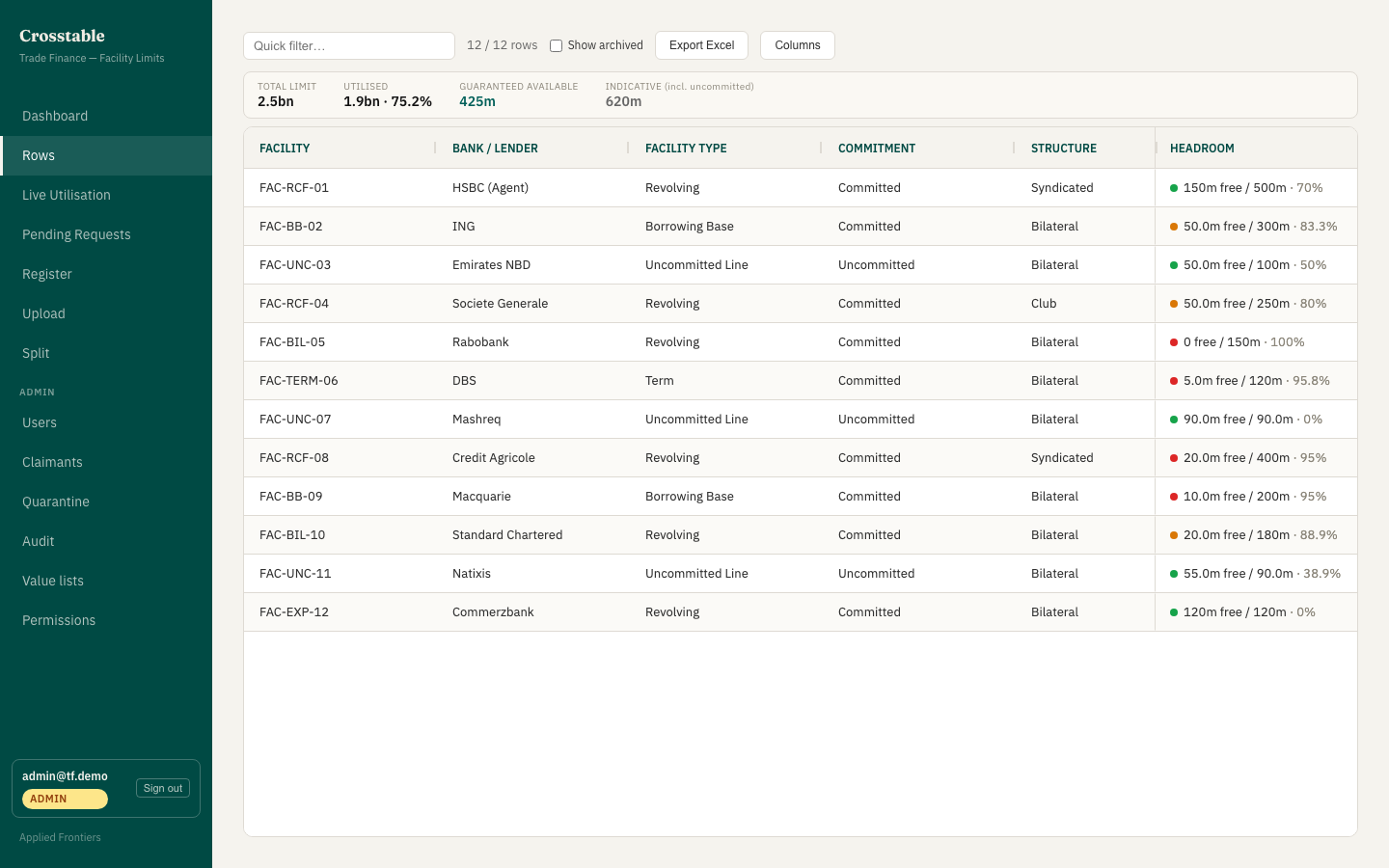
Consumed limit is tracked as cash drawn, so open letters of credit and guarantees quietly use headroom nobody has subtracted.
A drawdown fits the master facility but breaches its instrument sub-limit — a distinction a flat cell on a sheet cannot make.
Uncommitted, bank-discretionary lines are added into the same total as committed capacity, inflating the number treasury relies on.
One analyst both enters and releases a drawdown; there is no four-eyes, and a transcription error can sit undetected until drawdown.
A facility is a pool with a ceiling, and every drawdown uses part of it: what's outstanding can never exceed the limit. The distinctive part is nested sub-limits — a draw can fit the master facility yet breach its instrument sub-limit, so Crosstable checks both at once. Utilisation spans funded and contingent exposure, committed and uncommitted capacity are reported as separate numbers, and the whole journey of a drawdown — including net-zero rollovers and contingent-to-funded conversion — runs on maker-checker separation of duties.
A drawdown is checked against both its instrument sub-limit and the master facility at once — what's available is whichever has less room.
Every instrument carries a contingent-vs-funded flag; a live LC consumes the contingent sub-limit until it expires or converts to a funded bill.
Two computed availability numbers — guaranteed (committed only) and indicative (including discretionary uncommitted lines) — so treasury never over-promises.
Availability is time-bounded by each facility's effective-to-expiry period, and draws cannot mature past expiry.
Repaid amounts become re-drawable, rollovers net to zero headroom impact, and undrawn committed capacity is priced as the reservation it is.
Crosstable keeps the pool's arithmetic honest everywhere. The parts that differ firm to firm are the setup conversation.
The shape of your sub-limit tree and whether buckets are fungible or ring-fenced.
Borrowing-base dynamics — eligible collateral, advance rates, reserves and recompute cadence.
Covenant definitions and the test dates that can freeze or shrink availability.
Your committed-vs-uncommitted headroom policy and FX base currency, rate source and revaluation cadence.
The actual graph of banks, facilities and roles — mirrored locally, since bank limits arrive as a signed PDF and are re-keyed, not fed electronically.